
Written by Alexandre Bridi
19 October 2026 · 7 min read
Imagine an AI agent tasked with preparing an investment briefing on Europe's energy markets. It searches dozens of websites, retrieves market data, consults industry reports and comes across a particularly relevant piece of research.
The server responds: HTTP 402 Payment Required.
Access costs $0.50.
Until recently, that would have been an awkward point for autonomous software to encounter a human-designed checkout process. Today, an agent equipped with a payment-enabled client can handle the transaction itself, using protocols such as x402.
The server specifies the payment requirements. The agent checks its spending permissions, authorizes payment and retries the request. Once payment is verified and settled, the content is delivered.
No credit card form. No subscription. Potentially, no human involvement at all.
The process sounds almost disappointingly straightforward. But it raises two questions that a payment protocol cannot answer on its own: was the report worth buying, and what is the agent entitled to do with it?
These questions could prove more consequential than the mechanics of moving money.
The price of a request
In September 2026, Cloudflare introduced its Monetization Gateway in closed beta, allowing participating sellers to charge automated clients for access to APIs, datasets and other digital resources using x402.
The appeal is obvious. The web's commercial infrastructure was largely built around humans: page views, advertisements, subscriptions and purchases. AI agents need something different. They can consume information without ever visiting a homepage, seeing an advertisement or clicking a subscription button.
Yet a system that can pay for every request is not necessarily one that should.
Consider our investment-research agent. Suppose it retrieves 100 paid articles while preparing its report, but ultimately relies on just four. At ten cents per retrieval, the exercise costs $10. If it were charged the same nominal amount only for the four articles used in the final analysis, the bill would be 40 cents.
This is a hypothetical illustration, not a prediction of market prices. But it exposes a genuine commercial dilemma.
Charging for access is simple to administer. Unfortunately, it also makes exploration expensive. An agent must often inspect a source before it knows whether the information is useful. Put a price on every inspection and you risk encouraging agents to favour cheaper, potentially inferior sources.
Charging for actual use better aligns payment with the buyer's benefit. But it introduces another problem: how does the publisher know what the agent really used?
An article might influence a conclusion without appearing in the final citations. A research report might inform an AI-generated answer without any text being reproduced. Counting hyperlinks is a poor substitute for measuring informational contribution.
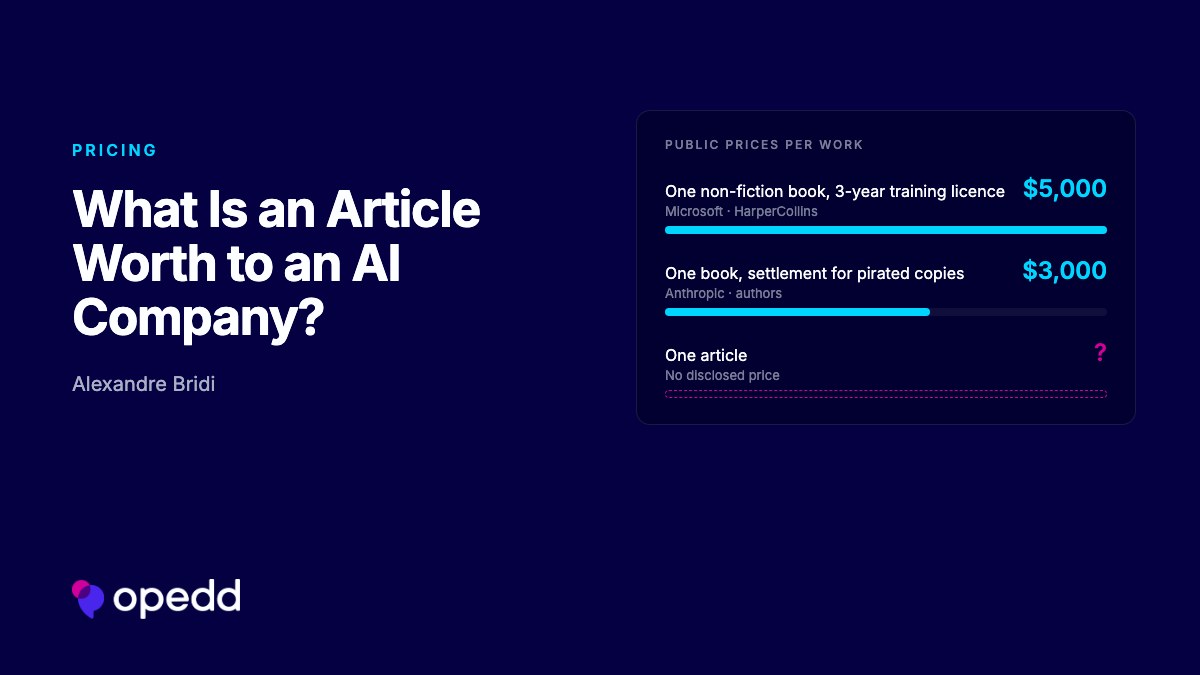
The distinction matters because publishers are not necessarily selling page views to AI companies. They are selling access to expertise, original reporting and proprietary information that can improve an AI product.
And the value of that information depends heavily on what the buyer intends to do with it.
Buying access is not buying every right
Return to the $0.50 research report.
The agent has paid, downloaded the document and incorporated its findings into an investment briefing. Fair enough—provided the applicable terms and law permit that use.
But what if the operator now wants to store the report in a commercial research database? Display substantial excerpts to thousands of subscribers? Incorporate it into a training dataset?
Those are different activities, potentially requiring different permissions and prices.
A successful payment proves that a transaction occurred. It does not, by itself, establish unlimited intellectual-property rights.
This distinction is already familiar in traditional publishing. A newspaper subscription does not automatically allow a consulting firm to reproduce the entire newspaper in its commercial products. AI does not make those distinctions disappear; it makes them harder to manage at scale.
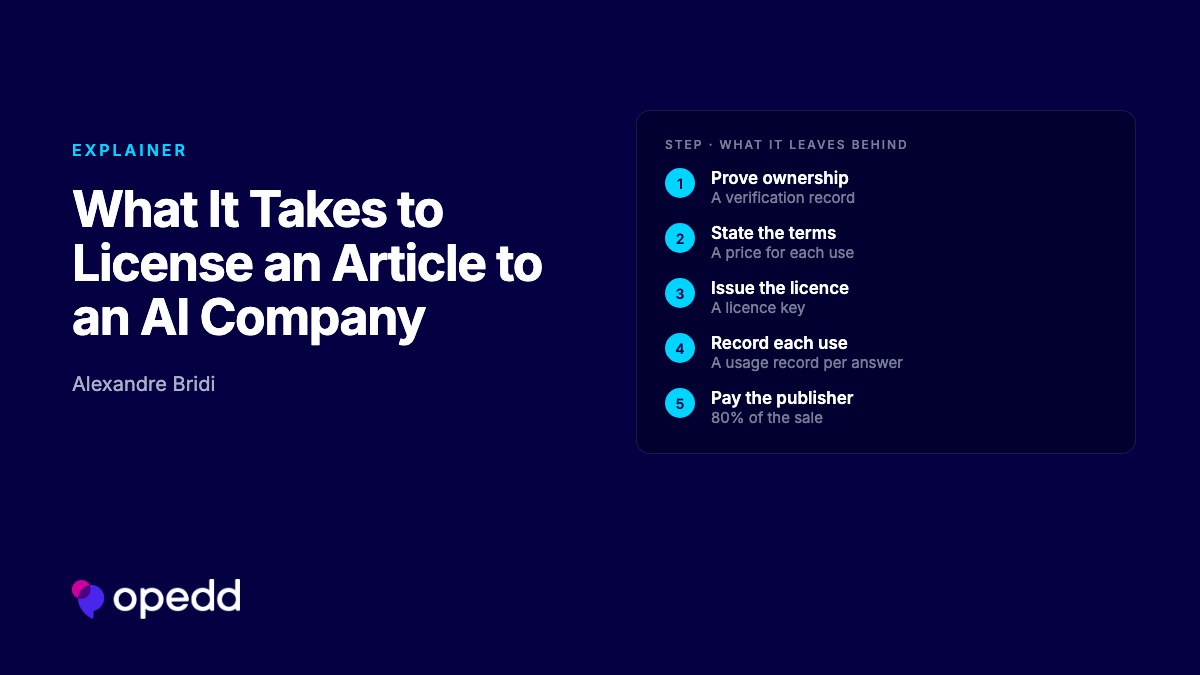
The industry therefore needs more than machine-to-machine payments. Buyers must be able to discover the relevant permissions, understand the price and conditions, obtain the appropriate rights, and retain evidence of what was agreed. Where copyright exceptions apply, those must also be considered rather than assuming that every automated use requires a paid license.
The standards are emerging. The market is still taking shape.
Several initiatives are already tackling different parts of this problem.
The Really Simple Licensing (RSL) standard allows publishers to express machine-readable permissions, restrictions and compensation terms. It already accommodates x402 as a payment method and supports requirements for usage reporting. Licensing and payments need not be separate systems.
Cloudflare is experimenting with the economics from another direction. Alongside its per-request payment gateway, it introduced Pay Per Use in September 2026. In that model, a buyer offers a price for a defined use, a publisher chooses whether to accept, and the buyer reports usage for billing and payment.
The SPUR Coalition, backed by publishers including the BBC and Financial Times, is addressing the reporting problem. Its Content Telemetry Standard, published in October, defines events such as retrieval, grounding, citation and presentation. On October 13, The New York Times, The Economist, AFP and The Atlantic were announced as new coalition members.
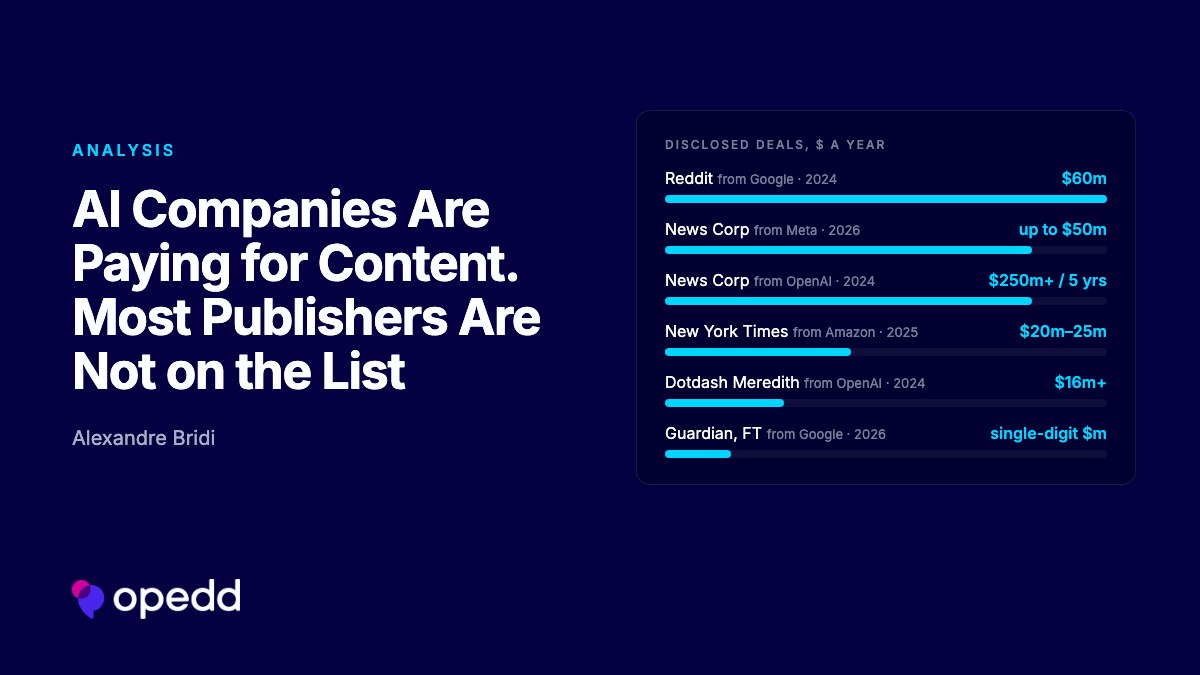
The significance is not that nobody had previously considered paying publishers. OpenAI's licensing agreements with the Financial Times, News Corp and other major media groups established the commercial precedent years ago.
What's changing is the attempt to make such transactions repeatable across many buyers and sellers, without negotiating a bespoke contract for every relationship.
That is considerably more difficult than adding a payment button to an API.
Machine-readable terms must be interpreted consistently. Buyers need confidence that sellers can grant the rights advertised. Publishers need confidence in the usage figures supplied by AI platforms. Both sides need records that can survive a procurement review, a contractual dispute or an audit.
None of those problems is automatically solved by a payment receipt. Nor does a reporting standard, without adoption and effective verification, guarantee an accurate account of downstream use.
What should happen after a 402?
For publishers, the immediate priority is to define what they are selling before deciding how to charge.
An API returning a current commodity price may be well suited to per-request payment: each successful request delivers the purchased service. A specialist investigation or proprietary research archive is different. A publisher might reasonably distinguish access for an individual answer from persistent storage, commercial display or model training.
Pricing everything as a page view risks overlooking those distinctions.
For AI developers, the purchasing decision should be governed by more than the agent's wallet balance. The agent needs an authorized budget, sufficient information to assess the resource, and a way to determine whether the available permissions cover its intended use. Where they do, it should acquire the necessary rights and retain the relevant transaction and license records.
Reporting billable downstream uses, where the agreement requires it, should be part of the same workflow.
At Opedd, this is the market we're building for: infrastructure that helps publishers make expert content available for licensing, allows AI buyers to procure defined rights through APIs, and creates verifiable records of those licenses. The objective is to make content licensing accessible beyond the handful of publishers large enough to negotiate directly with major AI labs.
There is still substantial work to do across the industry. In particular, verifying what happens to content after delivery remains harder than verifying that a license was issued.
But the commercial direction is becoming clearer.
The important innovation behind HTTP 402 is that software can encounter a price and complete a transaction. The next challenge is ensuring that the transaction makes economic and legal sense.
An agent encountering a paid article should be able to determine whether the information is useful enough to justify the price, whether the permitted uses match its task, and what evidence of the purchase must be retained. If those conditions cannot be satisfied, the sensible response may be to request approval, negotiate different terms or find another source.
The future market for AI content will not be determined simply by how easily machines can pay. It will depend on whether publishers and AI buyers can agree on what, precisely, is being bought.